It's 11pm and You're Googling "Dad Can't Hold a Fork Anymore"
What actually helps when a parent's hands start to shake — and the mistake almost every family makes first.
It's 11pm. The house is finally quiet. And you're on your phone, typing things you never imagined you'd have to type:
If that's you tonight — take a breath. You're not failing anyone. You've just walked into something thousands of families walk into every year, usually the same way.

It starts small. She switches to soup, then stops finishing it. He begins saying "I'm not hungry" — at his favorite meal. Then one Sunday it happens in front of everyone: the spoon trembles, the peas scatter, and your mother — the woman who fed this whole family for forty years — quietly sets down her fork and pushes the plate away.
And nobody says anything. That's the part that stays with you: everyone pretending not to see.
One husband put it simply in a tremor support community: "Eating has been a chore for him." A chore. The meal that used to be the best part of the day.
Here's what most families miss for months: she's not losing her appetite. She's avoiding an audience.
The good news — what actually helps costs less than you'd think, and it can change things at the very next meal. But almost everyone buys the wrong thing first. Here's why.
The three things that don't work
- 1"Just take your time, Mom." — Patience is kind. But careful hands still shake — slowing down just makes the audience watch longer.
- 2Helping with the fork. — Cutting her food turns into loading her fork, turns into feeding her. It solves the spill and creates something worse: a grown woman being fed like a child, in front of people she loves. If she seems to eat less the more you help — this is why.
- 3The $9.99 "adaptive utensils." — They arrive light as a plastic toy. The foam grip slides, a head snaps in the dishwasher, and within two weeks they're at the back of a drawer.
None of this failed because you didn't try hard enough. It failed because none of it touches the actual problem.
The real reason — it's not her hands
Here's the thing nobody tells you: your mother didn't fail at eating. Her silverware failed her.
Ordinary utensils are engineered for steady hands — as thin and light as manufacturers can make them. For a steady hand, light feels elegant. For a trembling hand, light is the enemy: every tiny shake races down that skinny handle and gets bigger by the time it reaches the food.
Film crews solved this problem decades ago. You can't stop a camera operator's hands from shaking — so nobody tries. They mount the camera on something heavy. Weight absorbs shake. It's why tripods exist.
A feather-light spoon is a camera with no tripod.
And those $9.99 sets? They copy the look of adaptive utensils and skip the physics — some weigh less than the ordinary silverware they're meant to replace.
It's not her. It's not you. It's the utensil.
What to look for: Weight · Angle · Hold
Once you see the real problem, the fix stops being mysterious. Occupational therapists tend to check three things at mealtime:
Weight
A handle heavy enough to absorb the tremor before it reaches the food. The tripod principle, shrunk into a utensil.
Angle
A neck that bends toward the mouth, so a stiff wrist doesn't have to make the full turn. (After a stroke, or with arthritis, the wrist often simply can't rotate that far.)
Hold
A soft strap over the hand, so a weakening grip doesn't have to squeeze for the whole meal.
Weight calms the shake. Angle spares the wrist. Hold keeps it in her hand. The last section explained what went wrong. This is how families put it right — often at the very next meal.
The set we finally put our name on
When we started Hale & Kin, we assumed we'd simply find a set that did all three and point families to it. What we found instead was a pile of near-misses — weighted but rigid, bendable but feather-light, sturdy but styled like hospital equipment.
So we kept ordering and testing sets until one earned the family name on the box.
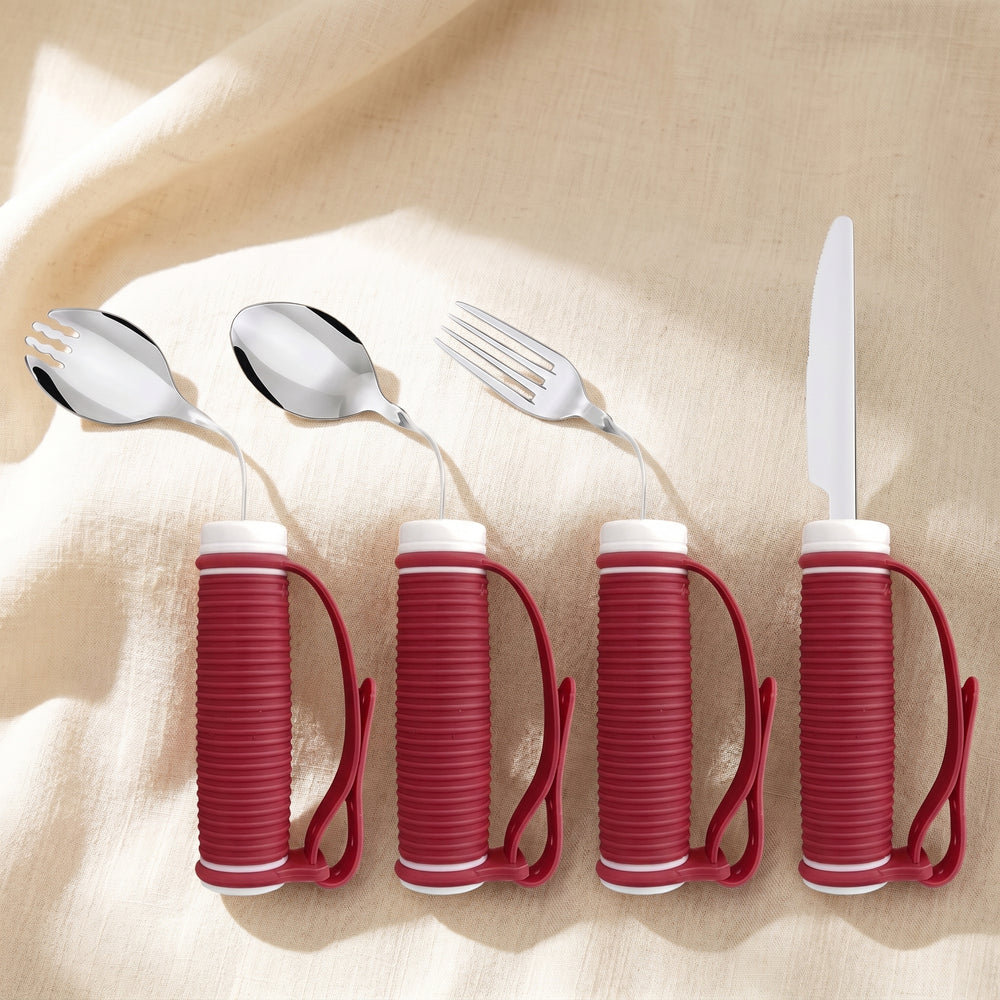
- ✓Weight — TPE soft-grip weighted handles, 92–114 grams each (fork 92 g · knife 103 g · spork 110.5 g · spoon 114 g). Heavy enough to steady, light enough to lift comfortably.
- ✓Angle — the spoon, fork, and spork bend to any angle and hold it; the knife stays rigid so it cuts safely.
- ✓Hold — an adjustable silicone wrist strap for the days grip runs low.
- ✓Food-grade 304 stainless steel heads. Real flatware — dishwasher-friendly, nothing "hospital" about it.
Honest note: most families notice the difference at the very first meal — soup that stays on the spoon. But give her a few days for confidence to catch back up, and expect the strap to feel new for a day or two.


The same meal, two different ways.
Built like it matters: 304 stainless heads, weighted TPE grips, silicone strap — the same materials checklist we'd want for our own parents.
And if we're wrong about your family's meal: every set is covered by the 30-Day Dignified Mealtime Guarantee — if her meals aren't steadier and easier, we refund everything and WE pay the return shipping.
We're a small, family-run shop, new and proud of how we got here: every set vetted by hand before it earns the Hale & Kin name. When you email us, a person answers.
"She no longer dreads mealtime," one caregiver wrote after switching her mother to weighted utensils. That's the whole job, really.
A few honest questions
If the tremor is severe, there are electronic stabilizing spoons — $195–$200 for a single utensil, with a battery to charge. For some families, eventually worth it. Most don't need to start there.

The Steady Mealtime Set — $99.95
- ✓Complete 4-piece weighted & bendable set (fork · knife · spoon · spork)
- ✓Adjustable wrist strap · food-grade 304 steel
- ✓Free US shipping · ships fast from the US
- ✓30-Day Dignified Mealtime Guarantee — we pay return shipping
Three meals a day, that's about nine cents a meal over the first year — for the whole table, not one utensil.
Or dinner stays the way it was last night.